 English
 Deutsch
 Czech
Czech
 Polski
 Italian
 French

Wall-mounted cat trees and scratchers make efficient use of vertical space while leaving more floor area free. This category includes flat and corner scratchers, vertical sisal posts, models with a single bed and large multi-level structures with hammocks and several resting areas. When choosing a wall-mounted model, consider your cat’s size, the dimensions of the usable surfaces, the support system and the type of wall. Read our guide: Wall-Mounted Cat Scratcher – How to Choose a Safe Model for Your Cat?


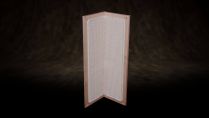
Cat tree to the outer corner
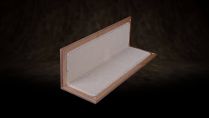
Scratcher to the internal corner

Mounted to the wall scraper "picture"


Scraper mounted to the wall - "Cat"

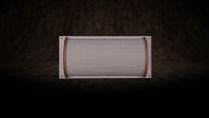
Cat tree to the wall


Corner cat tree for cats
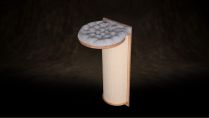
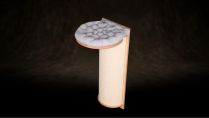
Cat tree to the wall

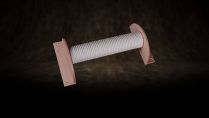
Pole mounted to the wall version A


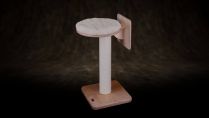
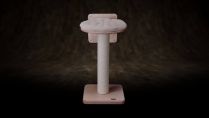
Cat tree with lair plate mounted to the wall
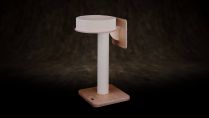

Cat tree with rosette - Wall mounted


Cat tree mounted to the wall, version 1
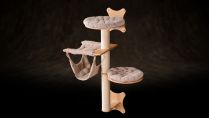
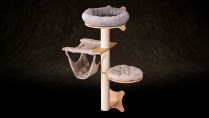
Cat tree mounted to the wall, version 1A


Cat tree mounted to the wall, version 1B
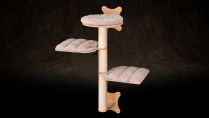
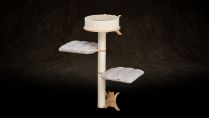
Cat tree mounted to the wall ver.2


Cat tree mounted to the wall ver.2A

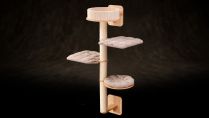
Cat tree mounted to the wall, version 2B

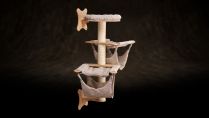
Cat tree mounted to the wall, version.3
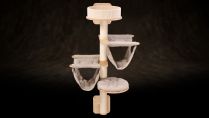

Cat tree mounted to the wall, version 3A
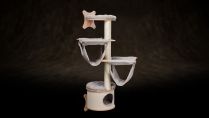
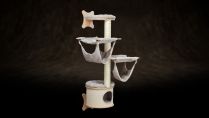
Cat tree mounted to the wall ver.4
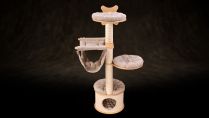

Cat tree mounted to the wall ver.4A
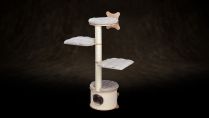
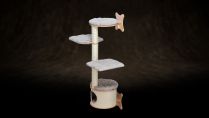
Cat tree mounted to the wall ver.5
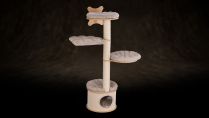
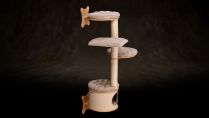
Cat tree mounted to the wall ver.5A
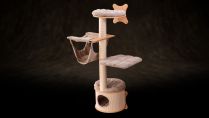
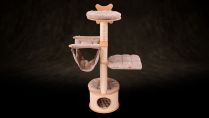
Cat tree mounted to the wall ver.6
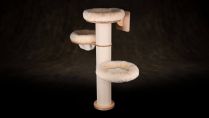

Cat tree mounted to the wall EX-KAK
Wall-Mounted Cat Trees and Scratchers
A wall-mounted cat scratcher may be a small surface designed primarily for claw maintenance or a large multi-level structure combining the functions of a scratching post, bed, climbing route and observation point. Wall mounting makes it possible to use vertical space efficiently, so this type of product works well both in small flats and in larger rooms where keeping the floor area clear is important.
This category contains models designed for very different purposes. You can choose a simple cat wall scratcher, a vertical sisal post, a construction with one resting place or a large wall-mounted cat tree equipped with several posts, hammocks, round platforms, rosette-style beds and houses. This makes it possible to match the product to the size of the cat, the number of animals and the space available in the room.
What Types of Wall-Mounted Cat Scratchers Are Available?
Flat and Corner Wall Scratchers
The simplest models consist of a wooden frame or board covered with a thick sisal mat. They sit directly against the wall and occupy very little space.
This type of scratcher can:
-
protect a selected section of wall;
-
protect an external or internal corner;
-
provide an additional scratching surface;
-
complement an existing system of wall platforms and beds;
-
work well in a small room.
Corner scratchers are particularly useful when a cat has already chosen the corner of a wall as its preferred place for scratching. Instead of trying to change the animal’s habits completely, the preferred location can be protected and adapted for this purpose.
Wall-Mounted Scratching Posts
A vertical sisal post allows a cat to scratch in a natural position and stretch its entire body. At the same time, it does not require a large base positioned on the floor.
When choosing this type of model, consider:
-
the length of the scratching surface;
-
the diameter and rigidity of the post;
-
the quality of the sisal rope;
-
the way the post is connected to the mounting brackets;
-
the spacing of the elements attached to the wall.
The diameter of a post alone does not determine its quality. The thickness of the internal tube, the construction of the post ends and the quality of the connections are equally important. These elements are explained in detail in our guide: How to Recognise a Truly Good Cat Tree.
Wall-Mounted Cat Scratchers with a Bed
A scratcher equipped with a round platform, rosette-style bed, padded cushion or another resting area combines a scratching surface with a wall-mounted cat bed.
In this type of product, the way the component onto which the cat jumps is supported is particularly important. The farther the bed projects from the wall, the greater the forces acting on the brackets and wall fixings.
Before choosing a model, check:
-
the actual usable size of the bed;
-
the surface area of the component positioned against the wall;
-
the number and spacing of the mounting holes;
-
the rigidity of the structure supporting the bed;
-
the way the post is connected to the remaining components.
Large Multi-Level Wall-Mounted Cat Trees
The largest models form a complete multi-level structure. They may include several posts, round platforms, rosette-style beds, single and double hammocks, houses and steps that make it easier to move between levels.
These cat trees are a good solution for active cats, animals that enjoy elevated resting places and multi-cat households. The individual resting areas are positioned at different heights, allowing cats to choose between open platforms, soft hammocks and more enclosed beds.
The Stability of a Wall-Mounted Cat Tree Depends on the Entire Structure
The fact that a cat tree is attached to a wall does not automatically make it stable. A cat does not only rest quietly on the platforms. It jumps onto them at speed, pushes off from the posts, climbs on the sisal surfaces and changes direction suddenly.
These actions create dynamic loads that can be considerably greater than the weight of a stationary animal.
Safety is influenced by factors including:
-
the size of the part of the cat tree positioned against the wall;
-
the number of fixing points;
-
the distances between the mounting holes;
-
the length and thickness of the supports;
-
the distance between the platforms or beds and the wall;
-
the rigidity of the connections between components;
-
correct protection of the components against rotation.
Several screws positioned very close together do not always distribute the load as effectively as fixing points spread across a larger surface. In large constructions, the complete arrangement of supports, posts, platforms and wall-mounted components is important.
Platform and Bed Sizes Must Suit the Cat
The total height or width of a cat tree does not show how much usable space the cat will actually receive. A visually large model may have several small elements that function mainly as steps.
Before ordering, check:
-
the width and depth of the platforms;
-
the diameter of round resting platforms;
-
the internal diameter of rosette-style beds;
-
the size of the hammocks;
-
the dimensions of the houses;
-
the length of the sleeping areas;
-
the distances between successive levels.
A cat should be able to step onto a bed, turn around and lie down comfortably. A large cat needs not only a construction with sufficient load-bearing capacity but, above all, appropriately sized usable surfaces.
For large breeds such as the Maine Coon, it is particularly important to check the actual dimensions of the resting area rather than relying only on the external diameter of the component.
A Wall-Mounted Cat Tree for Several Cats
In a multi-cat home, the overall size of the construction is not the only important factor. The number of independent resting places also matters.
A large wall-mounted cat tree for several cats should provide:
-
more than one full-sized resting area;
-
beds positioned at different heights;
-
comfortable routes between levels;
-
sufficiently long scratching surfaces;
-
safe routes for climbing and descending;
-
a construction that transfers loads through several points.
It is also important to consider whether the cats will be able to pass one another. A single narrow route may be blocked by an animal resting on a middle platform.
Materials and Quality of Construction
In a large wall-mounted cat tree, not only the appearance of the visible components matters, but also their internal construction and the way they are connected.
Important features include:
-
the thickness and rigidity of the material used for the platforms;
-
the strength of the components attached to the wall;
-
the quality of the posts and internal tubes;
-
the thickness and winding method of the sisal rope;
-
precise fitting of the supports;
-
the quality of the screws and structural connectors;
-
the possibility of retightening the construction during use.
If a gap remains between a support and a platform, the load may be carried mainly by the screws rather than being distributed across the complete joint. Over time, this may allow movement to develop.
Wall Type and the Correct Fixing System
The cat tree should be installed using components selected for the material from which the wall is made.
Different fixing systems are required for:
-
concrete;
-
solid brick;
-
hollow ceramic blocks;
-
aerated concrete;
-
plasterboard;
-
walls with timber or steel framing.
There is no single universal wall plug suitable for every surface. For some simple products, the customer selects the wall-fixing components individually. When a mounting kit is supplied with a larger cat tree, it is still necessary to confirm that the components are appropriate for the particular wall.
A heavy cat tree should not be attached only to the plasterboard itself without taking the supporting frame or a properly prepared reinforcement into account.
Before drilling, the location of electrical wiring, water pipes and other installations concealed inside the wall must also be checked.
How to Choose the Right Location for a Wall-Mounted Cat Tree
The installation location should be attractive to the cat while also allowing the construction to be used safely.
Rooms in which the cat and household members spend a considerable amount of time, such as the living room or an area near a window, often work best. A cat tree installed in a rarely used, isolated room may be less attractive to the animal.
Before installation, check:
-
access to the lowest level;
-
the amount of free space in front of the construction;
-
whether the cat can jump onto it freely;
-
whether a safe route for descending is available;
-
the distance from doors, windows and furniture;
-
the position of radiators, curtains and other interior elements.
Removable Covers and Spare Parts
Fabrics, sisal and cushion fillings are wear components that gradually deteriorate during many years of use.
Removable and washable covers make it easier to remove fur and dirt. Once the textile elements have been removed, the wooden surfaces can also be cleaned more thoroughly.
The availability of spare parts allows a worn component to be replaced without purchasing a completely new cat tree. The shop offers, among other products, replacement covers for wall-mounted cat trees designed for the corresponding models.
Before purchasing, check:
-
whether the covers are removable;
-
at what temperature they can be washed;
-
whether complete replacement cover sets are available;
-
whether a worn scratching post can be replaced;
-
whether the manufacturer supplies connectors and servicing components.
Wall-Mounted Cat Tree or Tree-Shaped Wall-Mounted Cat Tree?
A tree-shaped wall-mounted cat tree is one type of large wall-mounted construction, but it forms a separate product group.
Conventional wall-mounted scratchers may be small sisal panels, individual posts, beds or compact constructions equipped with hammocks. A tree-shaped model is a large piece of cat furniture designed in the form of a trunk with spreading branches.
Tree-shaped wall-mounted cat trees usually occupy a greater width of wall, provide a more extensive climbing route and have a distinctive decorative function. Conventional wall-mounted cat trees and scratchers make it possible to choose a more compact construction and adapt it more easily to a narrower section of wall.
How to Choose the Right Wall-Mounted Cat Scratcher
Before ordering, answer several basic questions:
-
How large is the cat?
-
Will the construction be used by one cat or several animals?
-
How long should the scratching surface be?
-
Are beds, hammocks or a house required?
-
How large are the actual usable surfaces?
-
How will the cat move between the different levels?
-
What material is the wall made from?
-
Do the platforms have suitable supports?
-
Can the textile elements be removed and washed?
-
Are replacement parts and covers available?
A properly selected wall-mounted cat tree should combine a suitable scratching surface, comfortable resting areas, a strong construction and a safe installation system. Matching the product to the cat, the number of animals and the particular room is more important than the total height, number of platforms or appearance alone.


