 English
 Deutsch
 Czech
Czech
 Polski
 Italian
 French

Cat beds include soft cushions and mattresses, enclosed hideaways, tunnels, hammocks, radiator beds and wall-mounted resting places. Individual models differ in shape, usable dimensions, filling, cleaning method and the way in which they are positioned or installed.
Choose a bed suited to the cat’s size and preferred sleeping position: an open surface for stretching, an enclosed hideaway, a warm hammock or an elevated wall-mounted platform. A cat bed can be used independently or complement a cat tree and the rest of the animal’s resting area.
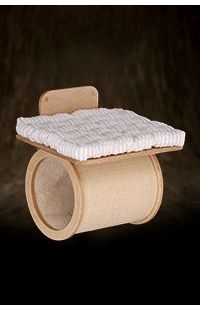
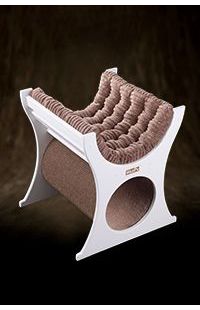


A mattress to the exhibition cage

Hanging cat box


The round reversible pouf
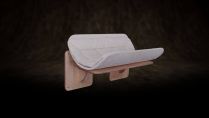
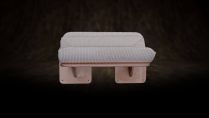
Gutter lair mounted to the wall, pernamently upholstered
Cat beds
Cat beds provide separate places for sleeping, resting and observing the room. Cats may nevertheless prefer very different forms of relaxation. One animal chooses a flat cushion, another an enclosed hideaway, while another regularly sleeps in a hammock, on a windowsill or on an elevated wall-mounted bed.
The collection therefore includes soft freestanding beds, wooden structures, hideaways, tunnels, radiator hammocks and wall-mounted modules. The parent category leads to two main sections:
- cat beds, hideaways, hammocks and cushions placed on the floor, furniture, windowsill or radiator and used inside show cages;
- wall-mounted cat beds and shelves used to create elevated resting places and complete wall routes.
Which cat bed should you choose?
Begin by observing where and how the cat already sleeps. Its habits may indicate a preference for:
- flat, open surfaces;
- soft raised edges surrounding the body;
- enclosed hideaways and houses;
- warm places close to a radiator;
- flexible hammocks that adapt to the body;
- elevated shelves and observation points;
- large surfaces for full-body stretching;
- compact beds for sleeping in a curled position.
A cat may also change its preferred bed during the year. It may choose a radiator hammock or enclosed house in winter and an open platform or windowsill during warmer months.
Open bed or enclosed hideaway?
An open cat bed may take the form of a cushion, mattress, padded bed, cradle or elongated wooden resting place. It gives the animal a wide field of view and makes it easy to change position.
An open design may be suitable for a cat that:
- likes to watch household activity while resting;
- often sleeps on its side or with its legs extended;
- does not willingly enter enclosed houses;
- requires easy access without a high entrance;
- frequently changes its sleeping place.
A cat house, igloo, tunnel or sleeping bag creates a more protected space. When choosing one, check the usable internal area, entrance dimensions and whether the cat can turn and lie down comfortably.
Cushions, mattresses and soft beds
Simple cushions and mattresses can be used on the floor, sofa, chair, shelf, windowsill or inside a larger hideaway. They take up relatively little room and can be moved between rooms.
The range includes round, rectangular and reversible models as well as beds with raised edges. Selected products use silicone-fibre filling or other soft materials. Always check the exact filling and cleaning instructions on the individual product page.
Compare:
- the actual usable sleeping surface;
- the thickness and resilience of the filling;
- whether the cover can be removed;
- whether the complete bed or only the cover is washable;
- the fabric texture and visibility of cat hair;
- stability on a smooth floor.
Cat houses, tunnels and sleeping bags
Enclosed models provide a roof and side protection, but their construction differs. An igloo usually has one entrance and soft walls, a tunnel allows the cat to pass through, and a sleeping bag creates a flexible hideaway.
Rigid wooden houses may contain a removable cushion and an additional resting area on top. This combines an enclosed interior with an open observation point.
Cat hammocks
A cat hammock creates a flexible surface that adapts slightly under the animal’s weight. Depending on the model, it may be a freestanding cradle, part of a wooden structure, a show-cage hammock or a radiator bed.
Before ordering, check the usable dimensions, fastening system, frame, removable cover, washing instructions and suitability for the cat’s weight.
Radiator cat beds
A radiator cat bed can suit an animal that regularly seeks warm places. Models differ in hook width, sleeping surface and frame design.
Measure the radiator and confirm:
- its thickness and upper profile;
- the distance from the wall;
- the stability of the hooks;
- whether the bed obstructs the thermostat;
- whether the surface temperature is suitable for the cat and fabric.
Wall-mounted cat beds and shelves
Wall-mounted products use vertical room space without occupying much of the floor. The range includes hammocks, round beds, elongated resting platforms, houses, shelves, steps, bridges and ladders.
A single wall-mounted bed can provide an independent resting point. Several modules can create a route leading from lower steps to an elevated hammock, house or shelf.
Planning must take account of:
- the wall material and load-bearing capacity;
- the correct type of fixings;
- the cat’s size and weight;
- distances between modules;
- a safe route up and down;
- access for cleaning;
- furniture positioned below the system.
How to select the size
Do not choose a bed only by the cat’s weight or breed. Two animals with similar weights may have different body lengths and sleeping positions.
Observe whether the cat usually curls tightly, lies on its side, stretches all four legs or shares a resting place with another animal. The usable sleeping surface is more important than the product’s external measurement, which may include thick sides or a wooden frame.
Cat beds for large cats
A large cat requires a spacious usable area and reliable support, especially in a hammock or on a wall-mounted platform.
Check:
- the internal or usable dimensions;
- the frame and supports;
- the number of mounting points;
- the entrance size of a house;
- whether the full body fits without excessive overhang.
One bed or several resting places?
A cat may move between different resting places depending on temperature, light and household activity. Even one animal may use a hideaway, cushion, windowsill and cat-tree bed during the same day.
In a multi-cat home, several independent places help reduce competition. Not every cat wants to share a bed, even when the animals usually have a good relationship.
Cleaning and washing
Cleaning depends on the construction. Some beds can be washed as a complete product, others have removable covers, while wooden models require separate cleaning of the frame and textile components.
Many products can be hand or machine washed at temperatures up to 40°C, but always follow the instructions provided for the individual model.
Before washing:
- remove loose hair;
- close fasteners as instructed;
- remove non-washable components;
- check the permitted temperature;
- dry the cover and filling completely;
- do not refit damp textiles to a wooden frame.
Fabric, colour and interior design
Fabric influences cleaning, appearance and how visible the cat’s hair will be. First select the correct size and construction, and only then choose the colour and texture.
A cat bed beside a cat tree
A bed can function independently or complement a cat tree. The cat tree provides scratching, climbing and elevated rest, while a separate cushion, hideaway or radiator hammock gives the animal a different temperature and level of enclosure.
Some beds also contain a small scratching surface. They can provide an additional place for claw maintenance but do not automatically replace a full-sized cat tree.
Where should a cat bed be placed?
Choose a location that reflects the animal’s preferences and remains easy to clean. Many cats choose a position from which they can observe the room without lying directly in a busy passage.
How to choose the right cat bed
Before ordering, compare:
- the cat’s size and body length;
- its usual sleeping position;
- open or enclosed construction;
- the actual usable sleeping area;
- the entrance size;
- the filling and frame;
- removable-cover options;
- washing instructions;
- the intended position or wall type;
- the number of cats using the product;
- how the bed will work with the cat tree and other feline furniture.
Compare cat beds, hideaways, cushions and hammocks with wall-mounted cat beds and shelves.


