 English
 Deutsch
 Czech
Czech
 Polski
 Italian
 French

Cat trees – playgrounds for cats are large, multi-level structures designed for scratching, climbing, playing, observing the surroundings and comfortable rest. They combine platforms, tubes, tunnels, hammocks, round beds and numerous sisal posts, creating several movement routes and independent spaces for one or several cats. Many models can be ordered in small, medium or large versions to match the cat’s build, activity and needs.
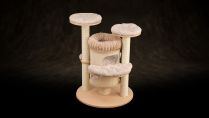
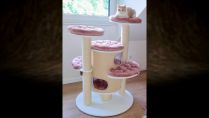
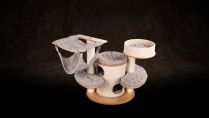
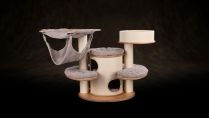
Playground PL-1
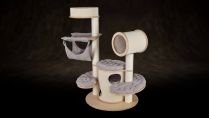
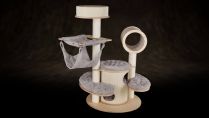



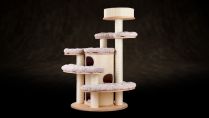
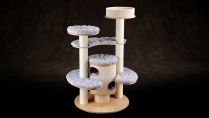

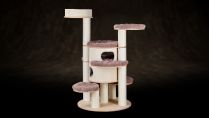
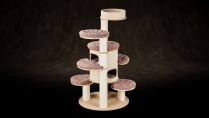

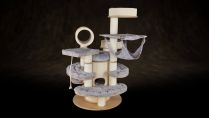
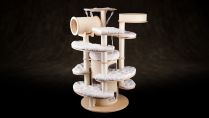

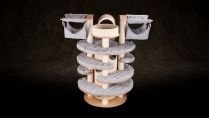
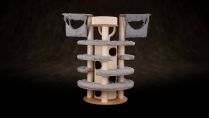


Cat trees – playgrounds for cats
Cat trees – playgrounds for cats are among the most extensive structures in Rufi’s wooden cat tree collection. They combine numerous scratching surfaces with platforms, hammocks, tubes, tunnels, cylindrical hideaways, round beds and enclosed resting places. A single cat playground can therefore serve as a scratching tree, climbing route, observation point, hideaway and extensive resting area.
These are not ordinary cat trees with a few randomly added accessories. Each structure should form a logical arrangement of levels and support points along which the cat can move comfortably. When designing a large cat tree, stability, overall proportions and the correct placement of platforms and beds are particularly important.
The collection includes models suitable for kittens and for small, medium and large cats. Many playgrounds are available in different size versions, allowing the base, platforms, tubes, round beds, hammocks and posts to be matched to the animal’s actual build. Breed alone should not determine the choice. Weight, body length, mobility, temperament and the number of cats using the structure are equally important.
How is a cat playground different from a conventional cat tree?
A conventional cat tree may consist of one or several posts and a limited number of beds. A cat playground is a more extensive structure. It provides different movement routes, several heights, multiple observation points and often more than one type of resting area.
A cat playground may include:
- long vertical posts wrapped with sisal rope;
- wide platforms forming climbing routes;
- tubes and enclosed hideaways;
- single or double hammocks;
- raised round beds and soft resting areas;
- tunnels or cylindrical passages for movement and hiding;
- several independent resting zones;
- components encouraging movement between levels.
The number of accessories alone does not determine the value of the construction. What matters is whether the components form a functional whole and whether the cat can climb, move to the next level, rest and descend comfortably.
An extensive cat tree for play, climbing and rest
Cats use space in three dimensions. They willingly move between the floor, furniture and elevated places from which they can observe their surroundings. An extensive cat tree organises these activities within one purpose-designed structure.
On a cat playground, an animal can scratch, stretch, climb, make short jumps, pass through tunnels, hide inside tubes and choose between open and enclosed beds. The different components support different behaviours, so the cat does not have to use the entire construction in one predetermined way.
One cat may regularly rest on the highest round bed, another may choose a hammock, while a third sleeps inside a tube. A varied construction allows each animal to select the place that suits its current needs.
Thoughtful movement routes between levels
A good cat playground should not be a random collection of platforms. Their placement and the order in which the animal can use them are important. Platforms, tubes, hammocks and beds should create clear routes for climbing, crossing and descending.
When assessing a large structure, consider:
- whether the cat can begin climbing from more than one side;
- whether the distances between levels match its mobility;
- whether it can descend by a different route;
- whether a resting cat can block the only passage;
- whether projecting beds restrict access to other elements;
- whether all key resting areas provide enough usable space.
A thoughtful layout is especially important in a multi-cat home. Several routes reduce situations in which one animal occupies a strategic position and prevents the others from reaching higher levels.
What makes a large cat tree stable?
A large cat tree is subjected to forces not only when a cat rests quietly. Much greater loads occur when an animal jumps onto it at speed, climbs a post, changes direction suddenly or plays with other cats.
Stability results from the cooperation of several elements:
- a suitably large and rigid base;
- multiple properly distributed support points;
- appropriate proportions between height and width;
- correctly positioned structural posts;
- rigid platforms and wooden components;
- avoiding excessive leverage on one side;
- strong connections between the levels;
- correct assembly and periodic checking of all connections.
Stability should not be judged only by the total weight of the product or the diameter of one post. The geometry of the complete structure and the way loads are transferred between the base, posts and platforms are equally important.
Safety as a design priority
Safe use of a large cat playground must be considered during the design process. This involves stability as well as distances between levels, entrance dimensions, the usable size of beds and the route to the highest components.
The construction must suit the individual animal. A model suitable for a young, agile cat may be less practical for an older animal, a cat with joint problems or one that moves cautiously at height.
After assembly, place the cat tree on a level, stable surface and check every connection. Inspect the tightness periodically, particularly when several active cats use the playground.
A cat playground matched to the animal’s size
An important feature of this collection is the ability to match many models to cats of different sizes. Small, medium and large versions may differ in the dimensions of the base, platforms, tubes, round beds and hammocks, as well as the diameter of structural components.
A similar functional layout can therefore be prepared as:
- a cat tree for a small cat or kitten;
- a cat tree for a medium-sized cat;
- a cat tree for a large cat with a long, substantial body.
Not every model offers the same set of size options, so always check the configuration of the individual product. Actual usable measurements are more important than the labels “small”, “medium” or “large”.
Cat playgrounds for different breeds
Cat playgrounds can be matched to cats of many breeds and to mixed-breed domestic cats. A correctly configured model may suit a small animal, a medium-sized cat or a member of a large breed.
Breed is only a guideline. Two cats of the same breed may differ in weight, body length, temperament and mobility. Compare the cat’s dimensions with the actual sizes of the beds, tube entrances, platforms and hammocks.
For structures developed specifically for very large animals, also explore our EX-MAX and EX-KAK cat trees for large cats.
A playground for one cat
An extensive playground is not reserved for a large group of animals. One active cat may use different parts of the structure according to the time of day and its current mood.
It may watch the surroundings from the highest platform in the morning, climb the posts during play and later rest in an enclosed tube or hammock. The number of functions allows the cat to change places without leaving its own activity zone.
A cat tree for two or several cats
A cat tree for several cats should provide more than one attractive resting place. If only the highest platform is genuinely comfortable, it may quickly become a source of competition.
In a multi-cat home, consider:
- the number of full-sized resting areas;
- the variety of open and enclosed beds;
- several scratching surfaces;
- more than one climbing and descending route;
- the possibility of maintaining distance between animals;
- stability during simultaneous use.
A large cat playground may work for siblings, two adult cats, a feline family or a larger group. The appropriate number of users nevertheless depends on their size, relationships and the number of genuinely usable beds.
Platforms as movement routes and observation points
Platforms are not merely additional beds. They create routes between the lower and upper sections, allow the cat to change direction and provide stopping points at different heights.
The shape and position of each platform should allow comfortable landing. Compare the genuinely usable area rather than only the maximum external dimensions.
Hammocks and round beds
Hammocks adapt to the body and are often chosen by cats that enjoy soft, gently enclosing resting surfaces. Round beds with raised edges create clearly defined places from which the animal can observe the room.
Larger playgrounds may contain single hammocks, double hammocks and round beds in different sizes. Their dimensions should correspond to the cat’s body length and weight and, in a multi-cat home, to the number of animals using the construction.
Tubes, tunnels and hideaways
Enclosed elements give the cat a place to rest away from household activity. A tube may contain several levels, while a tunnel or cylindrical passage creates a short movement route and an additional play area.
The internal dimensions must match the animal’s size. The cat needs enough room to enter, turn and lie down comfortably. For structures centred around a multi-level cylindrical body, visit our cat trees – towers and tubes.
Surfaces for scratching and stretching
A playground must remain a functional cat tree. Numerous posts provide scratching surfaces accessible from different sides and levels. Longer sections allow the cat to place its front paws high and extend its body.
Post placement also affects usability. A scratching surface should remain easily accessible rather than being obstructed by a platform, hammock or another component.
A playground for an active cat
A young, active animal may intensively use the high levels, tunnels, posts and different movement routes. Look for a structure that permits frequent changes of direction and contains several elements encouraging physical activity.
A playground does not replace interactive play with the owner, but it can enrich the cat’s environment and provide access to various activities during independent use.
A model for an older or less mobile cat
A large construction may also suit an older cat when the level arrangement matches its abilities. Smaller distances between platforms, a clear entrance route and easily accessible beds may be more important than maximum height.
Older cats do not necessarily want to give up elevated places. Correctly arranged levels can allow gradual climbing without requiring one large jump.
Functional and visual personalisation
Many models allow the size and finish of individual elements to be selected. The exact options depend on the product but may include:
- the size of the construction;
- the type and colour of textile material;
- the wood colour;
- the rope and sisal mat colour;
- the finish inside the tube;
- the type of top section;
- components fitted beneath the base.
Select the appropriate size and functional layout first, then coordinate the colours with the room. Appearance cannot compensate for undersized beds or an impractical climbing route.
Removable covers and replaceable parts
Depending on the model, cushions, covers and hammock fabrics may be removable. This facilitates hair removal and periodic cleaning of the areas used most frequently.
The possibility of ordering replacement covers, posts or other parts allows an intensively used playground to be refreshed without replacing the complete structure.
How to measure the space for a large cat tree
Consider more than the base dimensions. Platforms, hammocks, round beds and tunnels may project beyond the base, so the complete width and depth are important.
Before ordering, check:
- the height of the room;
- the full width of the construction;
- the direction in which the largest platforms extend;
- the space required for jumping on and off;
- free access to all tube entrances;
- the distance from doors, radiators and frequently moved furniture;
- the route for carrying large components into the selected room.
A playground should stand where the cat naturally wants to spend time and observe household life. A large structure hidden in an unused room may be less attractive than one placed near everyday activity.
How to choose the right cat playground
Before deciding, compare:
- the cat’s size and weight;
- the number of animals using the structure;
- the usable dimensions of platforms, hammocks, round beds and tubes;
- the number of independent resting places;
- the distances between levels;
- the available scratching surfaces;
- the stability and distribution of support points;
- the complete dimensions of the construction;
- cleaning options and replaceable wear components.
The best cat playground is not necessarily the model containing the greatest number of parts. It should be matched to the animal’s size, activity and mobility while providing comfortable movement routes, stable support and several attractive resting areas.
Compare our cat trees – playgrounds for cats and choose a small, medium or large version. Other designs are available in the main collection of exclusive cat trees made of varnished wood.


