 English
 Deutsch
 Czech
Czech
 Polski
 Italian
 French


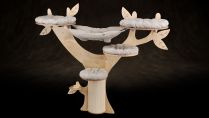

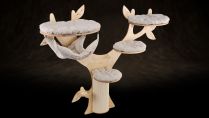
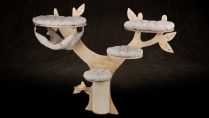
Tree-Shaped Wall-Mounted Cat Trees
Wall-mounted cat trees – a scratching area, climbing route and resting place
A tree-shaped wall-mounted cat tree is an extensive construction designed to resemble a trunk with spreading branches. Platforms, steps, beds, hammocks and scratching surfaces are attached to its individual sections. The complete structure functions as a scratching area, a vertical climbing route, an observation point and a comfortable place to rest.
Unlike a traditional free-standing cat tree, this type of construction does not require a large base placed on the floor. Its branches and structural supports are fixed directly to the wall, allowing the vertical space of the room to be used while leaving the floor beneath the tree unobstructed.
This does not mean that a wall-mounted cat tree is a small product. The models in this category range from 135 to 198 cm in width and from 151 to 171 cm in height. Before ordering, measure the available wall carefully, check the position of nearby furniture and leave enough free space for the cat to jump onto the construction and descend safely.
How does a tree-shaped cat tree differ from an ordinary wall-mounted scratcher?
A typical wall-mounted scratcher may consist of a single scratching panel, post, platform, bed or several separate components. A tree-shaped cat tree is a complete spatial construction in which the branches, platforms, supports and resting areas form one integrated system.
The cat can move between different levels, jump onto projecting branches, choose between several resting areas and observe the room from an elevated position. Such a structure can serve as the main cat tree for one animal or as an extensive climbing and resting area for several cats.
Customers looking for smaller scratching panels, posts, platforms, beds and other independent wall components can visit our wall-mounted cat trees and scratching posts category.
How to choose the right wall-mounted cat tree
The appearance of the tree is only one consideration. The cat’s size, weight, age and activity level are equally important. You should also consider the number of animals, the available wall width, the dimensions of the resting areas and the distances between successive levels.
A compact construction with several platforms may be suitable for a smaller, agile cat. A large animal needs longer and wider resting surfaces on which it can lie down, turn around and stretch its entire body comfortably. In a multi-cat household, the number of separate beds and the ability to move between them without blocking one another are also important.
Tree 1 – a compact model for small and medium-sized cats
The Wall Mounted Cat Tree – Tree 1 is 135 cm wide and 151 cm high. It includes resting areas measuring 60 × 41 cm and 40 × 40 cm, two steps and a 60 cm scratching section. It is the smallest model in this category and is suitable for one cat or a room with limited wall width.
Tree 2 – three separate resting areas
The Wall Mounted Cat Tree – Tree 2 is 142 cm wide and 151 cm high. It has three resting areas measuring 60 × 41 cm, 50 × 40 cm and 40 × 40 cm, one step and a 60 cm scratching section. It is a practical choice for a cat that regularly changes its resting place or for several smaller cats.
Tree 3 – an extensive construction for several cats
The Wall Mounted Cat Tree – Tree 3 is 187 cm wide and 165 cm high. It offers four resting areas, including a larger bed measuring 65 × 45 cm. Its greater width and number of levels make it suitable for homes in which several cats will use the construction.
Tree 4 – a large wall-mounted cat tree with a hammock
The Wall Mounted Cat Tree – Tree 4 is 198 cm wide and 171 cm high. It includes several conventional resting surfaces and a large hammock measuring approximately 70 × 47 cm. The variety of resting areas allows cats to choose between a soft hammock, padded beds and open platforms.
Tree 5 – the most spacious beds for large cats
The Wall Mounted Cat Tree – Tree 5 is also 198 cm wide and 171 cm high. Its equipment includes a particularly large 50 × 80 cm bed, a 65 × 45 cm resting area and a hammock measuring approximately 70 × 47 cm. Its generous usable surfaces make it especially suitable for large cats and breeds such as the Maine Coon.
The construction must withstand dynamic loads
A wall-mounted cat tree should be treated as a load-bearing structure rather than merely as a decorative feature. When a cat jumps onto a projecting platform, pushes off from a branch or changes direction suddenly, the construction is subjected to much greater forces than those produced while the animal is resting.
The rigidity of the plywood, the thickness and position of the supports, the accuracy with which the components fit together, the spacing of the wall fixings and the way the branches connect to the wall-mounted sections are all important. Gaps between components or incorrectly positioned supports may cause the load to be carried mainly by the screws instead of being distributed across the complete joint.
A detailed explanation of the construction, supports, platforms, wall fixings and differences between the models is available in our article: How does a wall-mounted cat tree differ from an ordinary cat tree?
Wall type and correct installation
The safety of a wall-mounted cat tree depends not only on the product itself but also on the way it is installed in the particular room. Screws, anchors and other fixing components must be selected according to the material and construction of the wall.
Concrete, solid brick, hollow ceramic blocks, aerated concrete and plasterboard walls require different mounting systems. A heavy cat tree must not be fixed solely to the plasterboard surface. The mounting points must connect to a sufficiently strong structural frame or to reinforcement prepared inside the wall.
Before installation, check the possible location of electrical cables, water pipes and other concealed services. When the wall structure or the correct type of fixing is uncertain, installation should be assessed by a suitably qualified person.
A replaceable scratching surface
The sisal-covered surface is a wearing component and will gradually deteriorate during years of regular scratching. Rufi wall-mounted trees use a separate scratching module that can be removed without taking the complete construction down from the wall.
This allows only the worn scratching section to be replaced while the trunk, branches, platforms and supports remain in position. It is especially useful for a large wall-mounted structure that has been colour-matched to the room and is intended to remain in use for many years.
The spare component is available as a replacement scratching element for Wall Mounted Cat Trees – Tree.
Removable textile components and easier cleaning
The padded beds and cushions used on the Tree models can be removed and washed at temperatures of up to 40°C. Once the textile components have been removed, the wooden surfaces remain easily accessible and can be cleaned thoroughly.
This is more practical than permanently covering all branches and platforms with upholstery. Removable components make it easier to remove fur, dust and other dirt without dismantling the tree from the wall.
Colours and finishes selected for the room
Because of its size, a tree-shaped cat tree becomes a prominent feature of the interior. Depending on the selected model, you can choose from the available wood finishes, sisal mat colours and types and colours of fabric used on the resting areas.
The decision should take into account not only the colour of the furniture and walls but also the lighting in the room, the visibility of cat hair on the selected fabric and how easy the upholstery will be to keep clean. The exact available options are shown in the configuration section of each product.
Where should a wall-mounted cat tree be installed?
A suitable location is a wall in a room where the cat and household members spend a considerable amount of time. Living rooms, areas near windows and positions providing the cat with a wide view of its surroundings generally work well.
Installing the tree in a dark, isolated room that the cat rarely visits may considerably reduce its usefulness. Leave enough free space in front of the construction for the animal to jump onto the lower steps and descend without striking a table, cabinet or other furniture.
A wall-mounted cat tree designed for long-term use
A well-designed tree-shaped cat tree should combine its distinctive appearance with functional platforms, adequately sized resting areas, rigid supports and correctly positioned wall-mounting points.
Before selecting a model, compare its total width and height, the actual dimensions of its beds, the number of levels and the route the cat will use to move between the branches. A correctly selected and installed construction can serve for many years as a scratching surface, wall-mounted climbing area, observation point and resting place.


