 English
 Deutsch
 Czech
Czech
 Polski
 Italian
 French

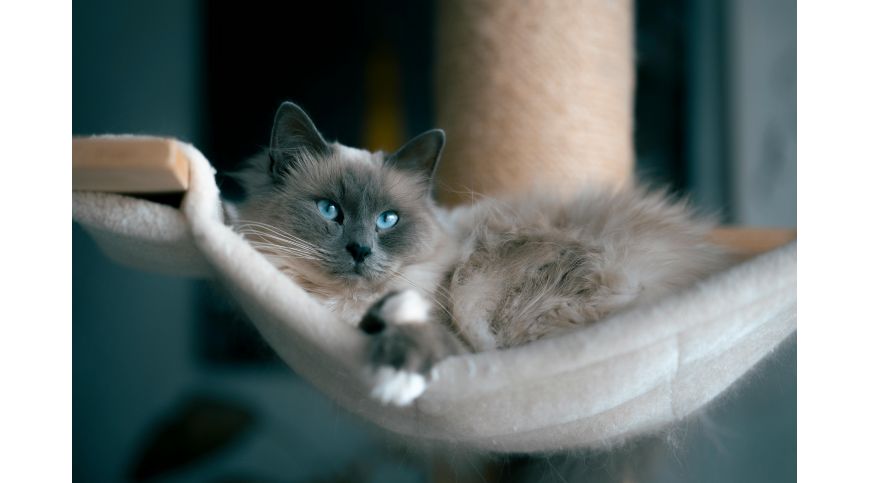
Wall-Mounted Cat Scratcher – How to Choose a Safe Model for Your Cat?
A wall-mounted cat scratcher may be a small scratching surface designed solely for claw maintenance, a vertical sisal post, a platform with a bed or a large multi-level construction equipped with hammocks, hideouts and observation areas. All these products are attached to a wall, but their construction, intended use and the loads transferred to the wall can differ considerably.
For this reason, when choosing a wall-mounted cat scratcher, you should not consider only its appearance, price or overall height. You should also check the size of the usable surfaces, the length of the scratching area, the arrangement of the supports, the way the components are connected and whether the structure can be securely fixed to the particular type of wall in your home.
The category of wall-mounted cat scratchers includes both simple models that occupy very little space and large constructions that function as scratching posts, beds, climbing routes and observation points. How should you select the right model, and what should you check before installation?
What Is a Wall-Mounted Cat Scratcher?
The terms “wall-mounted cat scratcher”, “cat wall scratcher”, “wall cat scratching post” and “wall-mounted cat tree” are sometimes used interchangeably. However, they do not always describe the same type of product.
Wall-mounted scratching products include:
-
flat boards and decorative panels covered with sisal mat;
-
corner scratchers mounted on an external wall corner;
-
vertical sisal posts attached to the wall;
-
scratching surfaces combined with a single bed;
-
wall-mounted platforms, hammocks and rosette-style beds;
-
constructions partly supported by the floor and additionally stabilised against the wall;
-
large multi-level cat scratchers with several posts, hideouts and resting areas;
-
decorative tree-shaped wall-mounted cat trees with a trunk and branches.
The main purpose of a simple cat wall scratcher is to provide a comfortable place for claw maintenance and full-body stretching. A larger structure must also support the weight of platforms, posts, beds and several cats, as well as the forces created when cats jump, climb and push off from its components.
Different wall-mounted scratchers should therefore not be assessed according to exactly the same criteria. A flat sisal mat fixed directly against a wall behaves very differently from a platform projecting several dozen centimetres into the room.
Why Choose a Wall-Mounted Cat Scratcher?
The greatest advantage of a wall-mounted cat scratcher is its ability to use the vertical space within a room. This is particularly useful in smaller flats, narrow corridors and rooms where a large free-standing cat tree would obstruct movement or occupy valuable floor space.
A wall scratcher can be installed at a height suited to the cat’s size and mobility. A simple scratching surface may begin close to the floor, while beds and observation platforms can be positioned considerably higher.
A properly designed wall-mounted system can:
-
provide a vertical scratching surface;
-
allow the cat to stretch its whole body;
-
create a climbing route;
-
provide access to a high observation point;
-
offer resting places at different levels;
-
increase the usable space available to the cat without occupying much of the floor;
-
help protect walls, corners and furniture from scratching.
Wall mounting alone, however, does not automatically guarantee stability. Safety depends on both the construction of the scratcher and the correct selection of fixings for the particular wall.
A Scratcher Fixed to a Wall Is Not Automatically Stable
In a free-standing cat tree, most of the load is transferred through the base to the floor. In a fully suspended structure, the weight of the product and the cats using it must be supported by the wall fixings.
A cat also does not behave like a static object. It jumps onto platforms at speed, pushes off from posts, changes direction, hangs from the edge of a bed and climbs up scratching surfaces. These movements create dynamic loads that may be considerably higher than the weight of a cat sitting still.
The farther a platform, hammock or bed projects from the wall, the greater the leverage acting on the mounting area. Safety therefore depends not only on the cat’s weight but also on:
-
the distance between the centre of the bed and the wall;
-
the dimensions and weight of the component itself;
-
the direction from which the cat usually jumps;
-
the number of cats using the construction;
-
the position of additional supports;
-
the rigidity of the joints between individual components.
For this reason, a general statement that a product has a high load capacity or is suitable for a cat of a particular weight does not provide complete information. It is also necessary to understand how the entire structure is supported and how the loads are transferred to the wall.
Types of Wall-Mounted Cat Scratchers
Flat Cat Wall Scratcher
The simplest products consist of a board or shaped wooden component covered with sisal mat. They are fixed directly against the wall and project only slightly into the room.
One example is the cat-shaped wall-mounted scratcher. This type of product is particularly suitable as:
-
an additional scratching surface;
-
protection for a selected part of the wall;
-
a scratcher for a small room;
-
an addition to a larger set of platforms and beds;
-
a solution for a cat that prefers vertical scratching surfaces.
The forces acting on the fixings are relatively limited because the product sits directly against the wall and is not designed as a platform onto which a cat jumps.
Corner Cat Scratcher
A corner scratcher uses an external wall corner. It can protect a location that the cat has already chosen for scratching while giving the animal access to surfaces positioned at different angles.
Before installation, check that the corner is straight and that skirting boards, uneven plaster or projecting edges will not prevent the scratcher from sitting correctly against the wall.
Wall-Mounted Scratching Post
A vertical sisal post allows a cat to scratch comfortably and stretch its entire body while occupying considerably less floor space than a traditional free-standing cat tree.
Important features include:
-
the length of the post;
-
the post diameter;
-
the quality and thickness of the sisal rope;
-
the construction of the internal tube;
-
the way the ends of the post are made;
-
the rigidity of the wall-mounted brackets.
A large post diameter alone does not provide sufficient information about quality. More information about posts, sisal rope, internal tubes and structural connections can be found in our guide: How to Recognise a Good Cat Tree.
Wall-Mounted Cat Scratcher with a Bed
Another group combines a vertical scratching surface with a single resting place. One example is the wall-mounted cat scratcher with a bed.
This type of product must be assessed differently from a flat sisal panel. The cat jumps onto the bed and its weight acts at a certain distance from the wall. Particular attention should therefore be paid to:
-
the way the bed is supported;
-
the size of the part positioned against the wall;
-
the spacing of the mounting holes;
-
the rigidity of the component connecting the bed to the wall;
-
the usable size of the resting area;
-
the quality of the connection between the scratching surface and the other parts.
Large Multi-Level Wall-Mounted Cat Scratcher
The largest wall-mounted cat scratchers may include several posts, beds, a hideout, a single hammock, a double hammock, rosette-style beds and steps that make it easier to move between levels.
All components of such a structure must operate as one integrated system. It is not enough for each platform to be made from a strong material. The platforms, posts, supports and wall-mounted frame must also work together when a cat moves across the construction.
One example is the Wall-Mounted Cat Scratcher Version 4A, which offers several different resting and climbing areas.
In large models, locking systems, reinforcing screws and the correct tightening of all structural connections become particularly important. All joints should be fully secured before the completed construction is fixed to the wall.
Wall-Fixing Points and Structural Supports
One of the most important features of a wall-mounted cat scratcher is the arrangement of the points through which the loads are transferred to the wall.
A large number of screws can be beneficial, but only when they are positioned correctly. Several mounting holes placed very close together will not distribute the load as effectively as fixing points spread across a larger surface.
Before buying, check:
-
the size of the component positioned against the wall;
-
the number of independent wall-fixing points;
-
the distance between the mounting holes;
-
whether the structure has additional supports;
-
whether a platform rests on a structural support or is mainly suspended from screws;
-
whether individual parts are secured against rotation;
-
whether clear assembly instructions are available.
In a properly designed wall-mounted cat tree, the load should not be carried solely by one screw, a small bracket or a thin mounting plate. This is especially important for large beds, hideouts and components that project far from the wall.
Supports Must Match the Size of the Platforms
A support positioned beneath a platform or bed is not merely a decorative element. Its purpose is to carry part of the load and reduce the forces acting on the main wall connection.
The support should be matched to:
-
the width and depth of the platform;
-
the weight of the component;
-
the distance between the platform and the wall;
-
the expected size of the cat;
-
the direction from which the cat will jump;
-
the way the support is connected to the remaining structure.
A support that is too short, thin or incorrectly positioned may bend under load. It may appear stable when pressed gently by hand but still move whenever the cat lands on the platform.
The components should also fit closely together. If the support does not sit directly against the platform, a gap remains and the connection may be maintained primarily by tension in the screws. Over time, this may allow the structure to develop movement.
The Complete Connection System Matters
In a large wall-mounted cat scratcher, individual components must not move, rotate or work independently.
Before allowing a cat to use the construction, check:
-
whether all screws have been tightened;
-
whether all locking systems are fully engaged;
-
whether reinforcing screws have been installed;
-
whether the posts can rotate independently of the platforms;
-
whether there are gaps between the components;
-
whether the supports sit closely against the parts they are intended to reinforce;
-
whether the completed construction moves in relation to the wall.
Do not assume that tightening a random screw more firmly will correct poorly fitted components. If a joint has visible play or the parts do not sit correctly against each other, the cause should be identified before the product is used.
The Type of Wall Is Crucial
Even a very strong wall-mounted cat tree can be installed incorrectly if the wall plugs and screws are unsuitable for the material from which the wall is constructed.
Different fixing systems are required for:
-
concrete;
-
solid brick;
-
hollow ceramic blocks;
-
aerated concrete;
-
plasterboard;
-
walls with a timber or steel frame;
-
walls with additional insulation or internal cladding.
There is no single universal wall plug suitable for every type of wall. For this reason, the fixing components used to attach some simpler scratchers to the wall may need to be selected individually by the customer.
Larger constructions may include particular fixing components, but you should still confirm that they are suitable for the material and structure of your wall.
Installation on a Plasterboard Wall
A heavy wall-mounted cat tree should not be attached only to the plasterboard itself without considering the structure behind it.
For large platforms and multi-level constructions, the mounting points should normally be connected to a sufficiently strong frame or to reinforcement prepared within the wall. A standard fixing designed for lightweight decorative objects may not be suitable for a construction exposed to repeated dynamic loads.
When the location of the frame or the internal structure of the wall is unknown, the appropriate fixing system should be selected by a qualified installer.
Pipes and Cables Hidden Inside the Wall
Before drilling, you should also check for:
-
electrical cables;
-
water pipes;
-
heating pipes;
-
other technical installations concealed beneath the plaster.
The location of the cat scratcher should therefore be selected with both the cat’s comfort and the construction of the wall in mind.
How to Choose the Installation Location
A wall-mounted scratcher cannot be moved as easily as a free-standing model. Its location should be chosen before any holes are drilled.
A suitable installation location should:
-
be in a part of the home where the cat already spends time;
-
provide easy access to the lowest level;
-
not obstruct doors, windows or walkways;
-
allow the cat to descend safely;
-
not be directly above fragile objects;
-
leave enough open space in front of the platforms;
-
allow all fixing points to be installed correctly.
Cats often enjoy wall-mounted beds positioned close to family living areas or windows. However, an attractive view should not take priority over safety. Consider how the window opens, the position of curtains and radiators, and whether nearby objects could be knocked over.
Platforms and Beds Must Match the Size of the Cat
The overall dimensions of a wall-mounted cat tree do not tell you how much usable space the cat actually receives. A large construction may contain many decorative parts but still have relatively small platforms.
Before buying, check the actual usable dimensions of:
-
platforms;
-
round resting plates;
-
the internal area of rosette-style beds;
-
hammocks;
-
hideouts;
-
sleeping areas;
-
spaces between the different levels.
A cat should be able to step onto a platform, turn around and lie down comfortably. Large cats and breeds such as the Maine Coon need not only a structure with a greater load capacity but, above all, larger usable surfaces.
It is also important to distinguish between the external dimensions of a component and the area available to the cat. A raised-edge round bed may have a large external diameter, but part of that space is occupied by the rim. Similarly, a soft cushion may extend beyond its wooden support without increasing the rigid supporting surface by the same amount.
Distances Between Levels
A wall-mounted cat tree should form a logical climbing route. The cat must be able to reach each level and then descend safely.
Check:
-
the height of the first step above the floor;
-
the vertical and horizontal distances between platforms;
-
the direction of the entrance to a hideout;
-
access to hammocks and raised-edge beds;
-
the space available for turning;
-
whether the cat can descend without making a sudden jump from the highest platform.
Larger gaps may be an attractive challenge for a young, agile cat. An older cat, kitten or animal with restricted mobility may require smaller height differences and additional intermediate steps.
In a multi-cat household, also consider whether the cats can pass one another or choose an alternative route. A single narrow path may be blocked by a cat resting on one of the platforms.
The Scratching Surface Must Be Genuinely Functional
A wall-mounted cat tree may offer numerous platforms and beds, but it should still perform its primary function as a scratcher.
The scratching surface should be:
-
sufficiently long;
-
easy to access;
-
stable beneath the cat’s paws;
-
made from a material into which the cat can comfortably extend its claws;
-
positioned so that the cat can stretch naturally;
-
replaceable after it becomes worn.
A flat sisal mat may provide the scratching surface in simpler products. Larger constructions may also use posts wrapped with sisal rope.
A long vertical element is particularly important for cats that reach high with their front paws and stretch their entire body while scratching. A short surface installed too low may be used reluctantly even when it is made from a good material.
Is One Wall-Mounted Cat Tree Enough for Several Cats?
In a multi-cat home, the number of genuinely independent resting places and the way the cats move between them are just as important as the overall size of the construction.
A large wall-mounted scratcher for several cats should provide:
-
more than one full-sized resting place;
-
resting areas positioned at different heights;
-
more than one possible route for climbing and descending;
-
a sufficiently large scratching surface;
-
a construction that distributes loads across several points;
-
access to spare parts and replaceable wear components.
Do not assume that three small platforms automatically provide three comfortable resting places. One may function mainly as a step, another may be located too close to the next component, and only the third may allow a cat to lie down comfortably.
Cleaning a Wall-Mounted Cat Scratcher
Once installed, a wall-mounted cat scratcher remains in one position. The possibility of removing and cleaning individual components is therefore especially important.
Before buying, check:
-
whether the covers can be removed;
-
whether the manufacturer provides washing instructions;
-
whether cushions can be taken out;
-
whether the wooden frame can be cleaned after the textiles are removed;
-
whether fur will collect in inaccessible gaps;
-
whether worn components can be replaced without dismantling the entire structure.
Replaceable covers and scratching surfaces extend the useful life of the product. This is particularly important for large constructions that should not need to be discarded simply because one cover or sisal mat has become worn.
Spare Parts and Servicing
Wall-mounted cat scratchers are intended for intensive use. Sisal rope, mats, fabrics and cushion fillings will naturally wear over time.
Before purchasing, find out:
-
whether replacement posts are available;
-
whether replacement covers can be ordered;
-
whether the sisal mat can be replaced;
-
whether the manufacturer supplies replacement screws and connection components;
-
whether spare parts will remain available after several years;
-
whether replacing one part requires the entire construction to be removed from the wall.
The ability to repair one individual component has considerable practical and economic value. A strong frame can remain in use for many years when the parts exposed directly to claws, fur and dirt are replaceable.
Wall-Mounted Cat Scratcher or Tree-Shaped Wall-Mounted Cat Tree?
A tree-shaped wall-mounted cat tree is a particular type of large wall-mounted scratcher, but not every wall-mounted cat scratcher is a tree-shaped model.
A conventional cat wall scratcher may consist of a single scratching surface, a post, one bed or a compact construction containing several posts and hammocks. A tree-shaped model is designed as a large piece of furniture with a trunk and spreading branches.
Tree-shaped wall-mounted cat trees:
-
usually occupy a greater width of wall;
-
have several spreading branches;
-
create a more extensive climbing route;
-
have a strong decorative function;
-
use several independent supports and fixing points;
-
may provide several large resting places.
Conventional wall-mounted scratchers provide greater flexibility in terms of product size, price and function. You can choose a small sisal panel, a vertical post, a single bed or a more compact multi-level construction.
Detailed information about the design, supports, plywood thickness and fixing points of large tree-shaped models can be found in our guide: Wall-Mounted Cat Tree – How to Choose a Strong Tree-Shaped Cat Scratcher.
How to Match a Wall-Mounted Scratcher to Your Cat
Before selecting a model, answer several basic questions.
How Large Is the Cat?
Consider not only body weight but also body length, height and the position in which the cat usually sleeps.
How Does the Cat Prefer to Scratch?
Some cats prefer vertical posts, others scratch angled mats, and some prefer horizontal surfaces. Observe which furniture and locations the cat currently chooses.
Does the Cat Like High Places?
Models with high platforms and beds are suitable for cats that actively seek elevated observation points. A very tall construction may not be necessary for a cat that generally chooses low resting areas.
Will the Scratcher Be Used by Several Cats?
Additional resting places, a larger scratching surface and a construction designed to carry simultaneous loads in several locations will be required.
Is the Cat Young and Agile?
Kittens, older cats and animals with restricted mobility need easier routes and smaller differences in height between the levels.
Checklist Before Buying a Wall-Mounted Cat Scratcher
Before ordering, check:
-
What are the actual dimensions of the scratching surface?
-
Can the cat stretch its entire body while scratching?
-
How large are the platforms and beds?
-
Are the usable dimensions stated, rather than only the external dimensions?
-
How many wall-fixing points does the construction have?
-
How widely are the mounting holes distributed?
-
Do projecting platforms have suitable supports?
-
What materials are used for the frame and platforms?
-
Are the individual components secured against rotation?
-
Can the scratcher be correctly attached to the type of wall in your home?
-
Can the covers and cushions be removed for washing?
-
Are worn posts, mats and textile elements available as spare parts?
-
Are clear assembly instructions provided?
-
Are the highest resting areas accessible to your particular cat?
-
Does the construction provide a safe route for descending?
Frequently Asked Questions About Wall-Mounted Cat Scratchers
Is a Wall-Mounted Cat Scratcher More Stable Than a Free-Standing Cat Tree?
This cannot be determined without assessing the particular construction. A properly designed and installed wall-mounted scratcher can be extremely stable, but unsuitable fixings, incorrectly selected wall plugs or poorly supported platforms may create a safety risk.
Similarly, a heavy free-standing cat tree is not automatically stable if its base is too small or its components are poorly positioned.
Can a Wall-Mounted Cat Scratcher Be Installed on Plasterboard?
It may be possible, but only with a fixing system suited to the structure of the wall. For heavy cat trees, the mounting points usually need to be connected to a supporting frame or specially prepared reinforcement. A large construction should not be attached only to the board itself without checking what is located behind it.
At What Height Should a Wall-Mounted Cat Scratcher Be Installed?
The correct height depends on the product and the cat’s mobility. The scratching surface should be accessible from the floor or an easy intermediate step. Beds can be installed higher, but the cat must have a safe route for climbing up and descending.
Are Wall-Fixing Components Always Included?
This depends on the individual product. For some simple models, the customer selects the wall plugs and screws according to the type of wall. Larger constructions may include mounting components, but you should still check that they are suitable for your wall.
Which Wall-Mounted Cat Scratcher Is Suitable for a Large Cat?
Pay particular attention to the actual dimensions of the platforms and beds, the strength of the supports, the distribution of the fixing points and the route between levels. The phrase “for large cats” is not a substitute for specific measurements.
Does a Wall-Mounted Scratcher Need a Sisal Post?
No. A sufficiently long sisal mat can also provide an effective scratching surface. It should be firmly attached and positioned so that the cat can adopt a natural scratching posture.
Is It Worth Choosing a Model with Replaceable Components?
Yes, especially when buying a large construction. Sisal rope, mats and fabrics are wear components. Replacing these parts allows the original frame to remain in use without purchasing an entirely new cat tree.
Summary
A wall-mounted cat scratcher can be a highly functional solution in both a small flat and a large multi-cat home. It makes use of vertical space, creates additional resting areas and provides an attractive climbing route.
Its quality is not determined simply by the fact that it is attached to a wall. The most important factors are:
-
the design of the complete structure;
-
the size of the components positioned against the wall;
-
the distribution of the fixing points;
-
proper support for projecting platforms;
-
wall plugs and screws suited to the particular wall;
-
sufficiently large usable surfaces;
-
safe routes for climbing and descending;
-
the quality of the posts and scratching surfaces;
-
removable covers and the availability of spare parts.
Before buying, check the measurements carefully, assess the proposed installation location and consider how the cat will use each level. Only a combination of strong construction, correct installation and proper adaptation to the animal will create a safe wall-mounted cat scratcher that can serve your cat for many years.
Leave a Reply Cancel Reply