 English
 Deutsch
 Czech
Czech
 Polski
 Italian
 French

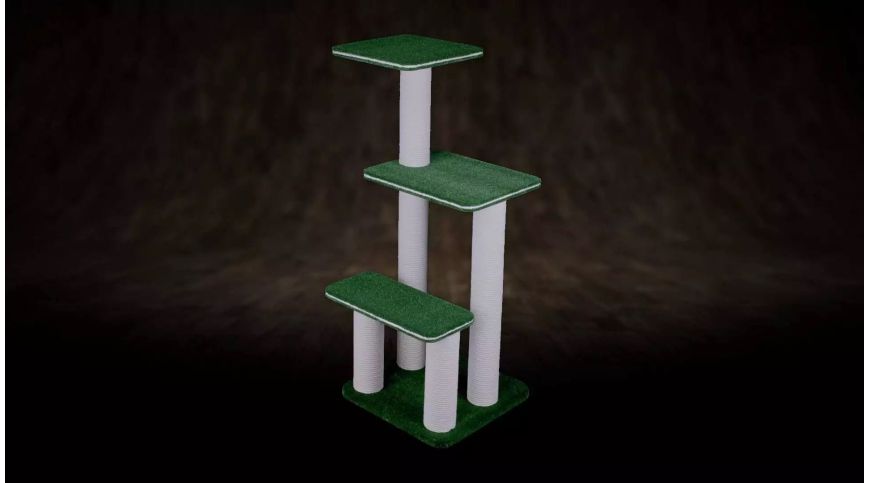
A cat tree for a balcony must be made differently from a standard indoor cat tree. The same applies to structures intended for a patio, terrace, catio, aviary or secured outdoor cat enclosure. Even a partially covered outdoor space is exposed to moisture, morning dew, wind-driven rain, sunlight, frost and frequent changes in temperature.
An ordinary indoor cat tree should therefore not simply be moved outside. Cardboard tubes, natural sisal rope, standard plywood, furniture board and conventional upholstery fabrics are not designed for prolonged exposure to outdoor conditions.
A properly made cat tree for a patio, balcony or catio should have a water-resistant structure, easy-to-clean surfaces and materials selected specifically for outdoor use.
See all outdoor cat trees for balconies, patios, catios and aviaries
Cat tree for a balcony – why is an ordinary indoor model not enough?
A balcony may appear to be well protected, particularly when it has a roof. In practice, wind-driven rain can reach even a covered balcony. Moisture, morning dew, condensation and temperature differences between day and night must also be taken into account.
A standard indoor cat tree may gradually absorb water. The most vulnerable components include:
- cardboard tubes inside the posts;
- natural sisal rope;
- unprotected edges of standard plywood;
- furniture board;
- upholstery foam;
- ordinary upholstery fabrics.
When these elements absorb moisture, they may swell, deform, delaminate, lose stability and take a long time to dry. A cat tree for a balcony should therefore be designed specifically for outdoor use rather than being an ordinary indoor model placed outside.
The cat tree itself does not make a balcony safe. The balcony must first be properly secured with netting, a fixed enclosure or another system protecting the cat against falling or escaping.
Cat tree for a patio or terrace – resistance to rain, sunlight and temperature changes
A cat tree for a patio or terrace is often exposed to more demanding conditions than a structure placed on a sheltered balcony. It may come into more frequent contact with rain, strong sunlight, wind, frost and rapidly changing temperatures.
Particular attention should be paid to:
- properly protected bases and platforms;
- posts resistant to moisture;
- scratching rope intended for outdoor use;
- surfaces that are easy to wash;
- a stable and substantial construction;
- correct positioning that allows water to drain away.
The cat tree should not stand where water collects around its base. Whenever possible, it is worth positioning it under a partial roof. Even a structure designed for outdoor use will retain its appearance for longer when it is not unnecessarily exposed to continuous heavy rain.
Cat tree for a catio or aviary – a structure for intensive use
A cat tree for a catio, aviary or outdoor enclosure should be selected according to the weather conditions as well as the number, size and activity level of the cats using it.
Outdoor enclosures are often used by several animals. Before choosing a model, consider:
- the number of platforms and full-sized resting areas;
- the length of the scratching posts;
- the distances between levels;
- convenient routes for climbing up and coming down;
- the dimensions of the base;
- the stability of the entire structure;
- easy access to every component during cleaning.
Young and active cats often enjoy tall multi-level structures. Older cats may need shorter distances between platforms and an easier route to the upper resting areas.
Why is natural sisal rope unsuitable for permanent outdoor use?
Natural sisal rope is an excellent material for indoor cat trees. It is rough, attractive to cats and provides a suitable surface for maintaining their claws.
However, it is not the right material for a structure permanently exposed to outdoor conditions.
Natural sisal:
- absorbs moisture;
- dries relatively slowly;
- is exposed to rain and morning dew;
- gradually loses its properties through repeated wetting and drying;
- is not designed for year-round exposure to changing weather.
For this reason, Rufi outdoor cat trees use a synthetic rope that imitates natural sisal. It retains a clearly textured scratching surface while resisting moisture, rain, sunlight, frost and temperature changes.
Natural sisal can be an excellent choice in a living room or bedroom, but a cat tree for a balcony or patio should use synthetic scratching rope intended for outdoor conditions.
Ordinary wood and standard plywood are not enough
The fact that a cat tree is made of wood or plywood does not automatically mean that it is suitable for outdoor use.
Standard plywood can absorb water, particularly through unprotected edges. Under the influence of moisture, its layers may separate while the surface can swell or deform.
Similarly, untreated wood is not automatically resistant to rain, frost, sunlight and repeated temperature changes.
The construction of an outdoor cat tree must take into account:
- the correct type of structural board;
- protection of all surfaces;
- careful protection of prepared edges;
- appropriate treatment of wooden components;
- materials intended for changing outdoor conditions.
Rufi outdoor cat trees use pressure-treated solid wood posts rather than the cardboard tubes commonly found in indoor models.
Proper varnishing is not only a matter of appearance
In outdoor cat trees made of varnished wood, the protective coating has a practical function.
Water-resistant plywood is additionally protected with marine or yacht varnish. The coating protects the prepared surfaces and edges, reduces moisture penetration and makes the structure easier to clean.
Simply coating an ordinary indoor cat tree with a random varnish does not turn it into an outdoor product. Varnishing must form part of a complete construction system that also includes suitable plywood, pressure-treated posts, synthetic rope and durable connections.
Two types of Rufi outdoor cat trees
Outdoor cat trees made of varnished wood
These models are intended for customers looking for a weather-resistant structure with a more classic, elegant and furniture-like appearance.
The collection uses:
- water-resistant plywood protected with marine varnish;
- pressure-treated solid wood posts;
- synthetic scratching rope intended for outdoor use;
- removable textile components.
See outdoor cat trees made of varnished wood
Removable covers provide the cat with a soft resting surface. Teflon-treated fabric with reduced water absorption is not completely waterproof, however. After heavy rain, wet covers should be removed and allowed to dry completely before being placed back on the cat tree.
Waterproof outdoor cat trees with artificial grass
The second collection uses black water-resistant structural boards and artificial grass intended for outdoor applications.
The structure is completed by pressure-treated solid wood posts and synthetic scratching rope resistant to outdoor conditions. The surfaces can be vacuumed, rinsed and thoroughly washed.
See waterproof outdoor cat trees with artificial grass
After intensive cleaning, the cat tree should be left in a warm and well-ventilated place until it is completely dry.
How to choose a cat tree for a balcony, patio or catio
Before ordering, compare more than just the overall height. Also check:
- the full width and depth of the structure;
- the outline of platforms extending beyond the base;
- the dimensions of the resting areas;
- the length of the scratching posts;
- the distances between levels;
- the number of cats using the structure;
- the size and activity level of the cats;
- the exposure of the location to rain and wind;
- access for cleaning and drying.
A compact model is usually the best option for a small balcony, provided that it does not block the door or help the cat reach above the safety net. A larger structure can be installed on a patio, but wind exposure must be considered. In an aviary or catio, the number of full-sized resting areas and the ability of several cats to use the cat tree simultaneously are particularly important.
Examples of outdoor cat trees
Cat tree W-1
A compact 108 cm model with one long scratching post and a large upper platform. It can be suitable for a smaller secured balcony or a patio with limited available space.
Cat tree W-3
A multi-level model with three large resting areas and posts measuring 40, 80 and 120 cm. It is suitable for a larger patio, catio or household with several cats.
Cat tree W-O-5
A tall structure with artificial grass, several levels, long scratching surfaces and multiple observation and resting areas.
See the waterproof W-O-5 cat tree
A waterproof cat tree still requires regular care
The term “waterproof” does not mean that the structure can be left without cleaning or inspection.
The cat tree should be regularly:
- vacuumed and cleared of hair;
- rinsed when necessary;
- checked for damage to surfaces and rope;
- inspected and retightened at all connections;
- allowed to dry completely after intensive washing.
The protective coating of varnished models should be checked periodically. Deep scratches or mechanical damage should be protected again. Wet textile components should not remain on the cat tree for long periods.
Summary
When choosing a cat tree for a balcony, do not focus only on its height and appearance. Materials and construction technology are the most important factors.
Natural sisal rope, cardboard tubes, ordinary plywood and untreated wood are not suitable for permanent outdoor use.
A suitable cat tree for a patio should use pressure-treated solid wood posts, synthetic scratching rope, water-resistant structural components and properly protected surfaces and edges.
The same requirements apply to a cat tree for a catio, aviary or outdoor enclosure, particularly when several cats will use it intensively.
Compare all outdoor cat trees for balconies, patios, catios and aviaries
Leave a Reply Cancel Reply