 English
 Deutsch
 Czech
Czech
 Polski
 Italian
 French

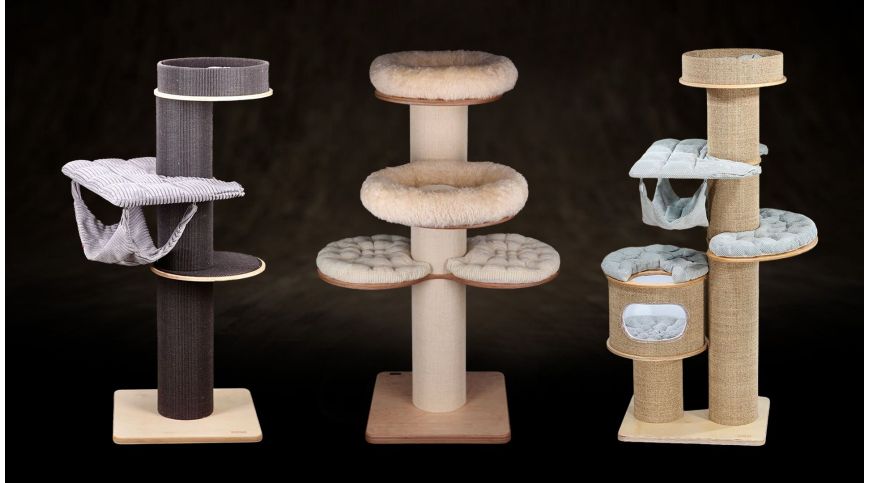
How to Choose a Cat Tree for a Large Cat? What to Look for in XL and XXL Models
When choosing a cat tree for a large cat, it is easy to focus first on its height, the number of beds or its appearance. With large and heavy cats, however, it is better to reverse that order. Safety and structural strength should come first, followed by functionality and dimensions, with design and colour considered last.
A large cat does not load a cat tree with its body weight alone. It jumps onto platforms, pushes off against posts, climbs, changes direction suddenly and may leap onto the highest bed at speed. The dynamic and lateral forces created by these movements are much more demanding on the structure than the weight of a cat resting quietly.
A good cat tree for a large cat should therefore be treated first and foremost as a functional structure in which the base, posts, platforms, connections and resting areas all work together correctly.
Terms such as “XL cat tree”, “XXL cat tree” or simply “large cat tree” are not technical standards. A large overall size or a thick post visible in a photograph does not automatically guarantee quality. The most important differences between a solid cat tree and one that begins to wobble over time are often hidden inside the posts and at the connection points – exactly where customers usually cannot see them.
If you are already looking for a specific model, you can browse our cat trees for large cats. Before choosing one, however, it is worth understanding which parameters really matter and what to compare between different constructions.
A Large Cat Is More Than Just Extra Weight
There is no single weight limit above which every cat automatically needs an XL or XXL cat tree.
Two cats weighing 7 kg each can have completely different needs. One may be relatively compact, calm and spend most of its time resting. The other may have a long body, a powerful build and use the cat tree every day for intensive climbing and jumping.
For this reason, weight is only one factor to consider. Body length, activity level, age, mobility, the way the cat jumps onto the structure and whether the cat tree will be used by one or several animals are equally important.
A cat tree for a large cat should be chosen for the individual animal and the way it uses the structure, not simply according to breed name or body weight.
Safety Matters More Than Appearance
In a small, low cat tree, damage to one component may primarily mean that the part needs to be repaired or replaced.
In a tall structure, the consequences can be more serious. If the connection of a lower post becomes loose, its end fitting is damaged or an excessively thin inner tube begins to flex, the movement can be transferred throughout the structure. The taller the cat tree, the more noticeable even a small amount of play at the bottom can become at the top.
For this reason, a large cat tree should not be chosen simply because it looks impressive in photographs, includes plenty of accessories or is described by the manufacturer as “XL”, “XXL” or “extremely stable”.
A much more useful question is:
What is the cat tree actually made of, and how does the structure transfer loads?
A Thick Post Is Not Always a Strong Post
Post diameter matters, particularly in large constructions. It should not, however, be the only parameter used to assess strength.
Two posts with exactly the same external diameter can be built very differently.
One may contain a thick, rigid inner tube, solid multilayer plywood end pieces, a securely installed nut and an appropriately sized threaded connection.
Another may use a thin tube combined with lightweight plastic fittings and small mounting components.
In product photographs, both posts may look almost identical. Their internal construction determines how they will behave after thousands of jumps, climbing sessions and repeated loads from a large cat.
When looking for a stable cat tree, it is therefore worth asking the manufacturer not only about the diameter of the posts, but also about how they are constructed internally.
The Inner Tube – the Hidden Skeleton of the Post
On many cat trees, what you see on the outside of a scratching post is mainly sisal rope. The actual structural element is hidden underneath.
Simply stating that a post contains a cardboard tube tells you very little about its quality. There is a major difference between a thin tube that is easily compressed and a thick, rigid tube designed to withstand repeated loads.
At Rufi, we use tubes with a minimum wall thickness of 10 mm. This provides the post with appropriate rigidity and allows its end components to be securely installed.
This becomes particularly important in large and tall cat trees. An excessively thin tube may bend, delaminate or gradually deteriorate around the point where the end fitting is attached. If this happens in one of the lower posts of a tall structure, the problem can affect not only durability but also overall stability.
The End of the Post Is Just as Important as the Post Itself
When looking at a cat tree, customers can easily see the sisal rope and the external diameter of the post. The component hidden inside its end is much harder to assess.
This is where the mounting system that connects the post to the base, a platform or another structural element is located.
In a solid cat tree for a large cat, the end of the post should be rigid, securely fitted and capable of handling forces acting from different directions for many years.
In Rufi constructions, we use end elements made from multilayer plywood together with M10 threaded connections. A large nut alone is not enough. It must be securely installed in a strong end piece, which in turn must work with a sufficiently durable inner tube.
This is why a cat tree should never be judged by one impressive-sounding parameter.
The complete system matters:
inner tube → end fitting → nut → screw → platform or base.
If one of these elements is weak, it limits the strength of the entire connection.
Why Do We Use M10 Connections in Large Cat Trees?
A tall, multi-level cat tree needs to be firmly and securely assembled.
During everyday use, the structure is constantly subjected to movement. A cat jumps onto it from different directions, pushes off against the posts, lands on projecting beds and suddenly changes the load placed on individual components.
In a small cat tree consisting of a base, one short post and a lightweight bed, a smaller connection may be sufficient.
For larger Rufi constructions, we use M10 connections because they make it possible to achieve a strong clamping force and a durable connection between the components. Of course, M10 alone does not guarantee stability. It needs to work together with a strong inner tube, a solid end fitting and a rigid platform or base.
This is why descriptions such as “reinforced construction” or “extra-strong posts” should be treated with caution when they are not supported by any specific technical information.
A good manufacturer should be able to explain how its cat trees are actually built.
The Base Must Be Rigid, Not Just Large
A common assumption is that the larger the base, the more stable the cat tree.
That is only partly true.
The base should certainly be appropriately sized, but its rigidity and the way it works with the position of the posts and upper components are equally important.
If a large bed is positioned high above the floor and extends far beyond the outline of the base, it creates a greater overturning moment. Even a heavy, wide base cannot always compensate for a poorly designed layout.
In large Rufi cat trees, we use bases made from 36 mm multilayer plywood. Rigidity is important because the base should not flex under loads transferred through the posts.
A large cat tree should be designed as one coherent structural system rather than as a random combination of a large base, thick posts and numerous beds.
A Platform Is More Than Just a Place to Rest
When buying a cat tree, platforms are usually assessed mainly according to their size and comfort for the cat. In reality, they may also perform an important structural role.
Platforms connect the posts and help reinforce the entire cat tree.
If they are too thin or bend easily, they move every time a large cat uses the structure. Over time, this movement can be transferred to the mounting points and contribute to looseness developing in the connections.
In Rufi cat trees, platforms are made from 18 mm multilayer plywood. This allows them to serve not only as usable space for the cat but also as structural elements that help reinforce the construction.
Once you know that a platform is sufficiently rigid, you can consider its second role: providing a comfortable place for the cat to rest.
A Large Bed Really Does Need to Be Large
The terms XL and XXL should not refer only to the overall height of the cat tree. A large cat primarily needs enough space to rest comfortably – somewhere it can lie down freely, turn around, stretch out and change position while sleeping. This means that the dimensions of platforms, hammocks, rosette beds, sleeping areas and houses matter just as much as the dimensions of the complete structure.
If spacious and comfortable resting areas are a priority, take a look at our range of upholstered cat trees for large cats. It is a useful place to compare different layouts, sizes and solutions designed specifically with larger cats in mind.
One model worth considering is the H-2A cat tree. When looking at any particular model, always check the stated dimensions of its individual components and compare them with the size of your own cat.
Product photographs are useful for assessing appearance and overall proportions, but for a large cat, the actual measurements should ultimately be more important. A properly sized resting area will simply be more comfortable in everyday use.
A Large Cat Should Be Able to Scratch at Full Stretch
The total height of a cat tree and the length of its scratching surface are two different things.
A cat tree may be two metres tall while still consisting entirely of short posts separated by platforms. In that case, a large cat still does not have a convenient place where it can fully stretch its body while scratching.
At least one easily accessible post should allow the cat to place its front paws high up and fully extend its torso.
Scratching is not only about maintaining the claws. Cats also use it to stretch their bodies intensively. A sufficiently long scratching section is therefore particularly important for larger cats and animals with long bodies.
Natural Sisal Does Not Automatically Mean Durable Sisal
As with scratching posts themselves, vague product descriptions should also be treated carefully when it comes to sisal.
A statement such as “the post is covered with natural sisal” does not tell you how long that scratching surface will withstand intensive use.
The quality of the fibre, rope diameter, weave, tension during wrapping and the way the rope is secured all matter.
A large and powerful cat may use the posts very intensively, which means that the quality of the scratching surface is far more important than an impressive-looking post circumference alone.
In cat trees intended for intensive use, we use thick, tightly woven sisal rope that is correctly wrapped around the post. Details like these explain why two apparently similar scratching posts can wear at completely different rates.
A Floor-to-Ceiling Cat Tree for a Large Cat – a Good Idea, but Only Under the Right Conditions
A floor-to-ceiling cat tree can be an excellent solution for a large and active cat.
It makes use of the height of the room, gives the cat more opportunities to climb and provides an additional point of support at the ceiling, which can significantly improve the stability of a tall construction.
There is, however, one important point to remember:
the fact that a cat tree is supported against the ceiling does not automatically make it stable or safe.
The tension mechanism is only one part of the complete structure. It cannot compensate for excessively thin inner tubes, weak post ends, inadequate connections or poorly designed platforms.
In a tall floor-to-ceiling cat tree, the quality of the complete load-bearing system is particularly important because the cat may be using the structure more than two metres above the floor.
A Floor-to-Ceiling Cat Tree Should Be Matched to the Height of the Room
Some floor-to-ceiling cat trees offer a very wide adjustment range. At first glance, this seems convenient because the same model can be installed in rooms with very different ceiling heights.
From a structural point of view, however, this is not always the best solution.
If a room is 265 cm high, for example, it is preferable for the cat tree itself to be close to that height, with the tension mechanism used mainly for final adjustment and secure pressure against the ceiling.
A much less favourable situation occurs when the main structure is considerably too short and the missing several dozen centimetres have to be compensated for by extending a screw or other adjustable element a long way.
The further the adjustable part is extended, the greater the demands placed on the mechanism itself. In weaker constructions, this can result in bending, looseness or damage.
For large and heavy cats, we therefore prefer floor-to-ceiling cat trees prepared with the actual room height in mind, so that the tension system only needs the adjustment range that is genuinely necessary.
What Should You Check When Choosing a Floor-to-Ceiling Cat Tree?
With this type of construction, a description such as “very stable tension-mounted cat tree” tells you very little.
It is worth finding out the diameter of the posts, the thickness of their inner tube walls, how the post ends are constructed, which threaded connections are used and how the tension system works, including its adjustment range.
For tall floor-to-ceiling structures, appropriately thick posts and inner tubes with wall thicknesses of around 8–10 mm or more are particularly important. At Rufi, we use tubes with a minimum wall thickness of 10 mm, and the cat tree itself is prepared with the actual height of the room in mind.
With a large cat, this is not an area where choosing solely by the lowest price is a good idea.
If the manufacturer or seller cannot provide basic technical information about the construction, it is worth being cautious.
A Cat Tree from a Mass-Market Store or a Specialist Manufacturer?
Not every inexpensive cat tree is bad, and not every expensive product is automatically good. Price and brand should never be the only criteria.
With large and heavily loaded structures, however, it is worth checking whether the manufacturer can explain how the cat tree is constructed, provide details about the materials and connection system, and offer access to spare parts and after-sales service.
If a cat tree is two metres tall but its description consists only of phrases such as “solid”, “XXL”, “for large cats” and “very stable”, you still know very little about how it is actually built.
For large cats, specific technical information is far more useful than marketing claims.
A Heavy Cat Tree Is Not Always a Stable Cat Tree
This is another common mistake when choosing a cat tree.
A high overall weight may contribute to stability, but weight alone does not guarantee it.
A heavy XXL cat tree can still wobble if the posts are poorly positioned, large components project far beyond the outline of the base, platforms bend easily or the connections are weak.
The centre of gravity is also extremely important. The heavier a component is and the higher and further away from the centre of the structure it is positioned, the greater the load transferred to the lower posts and connection points.
Instead of asking only:
“How much does this cat tree weigh?”
it is better to ask:
“How was it designed?”
One Large Cat and Several Large Cats Are Two Different Uses
If several cats use the same cat tree, the load on the structure is not simply the sum of their body weights.
One cat may be resting in the highest hammock while another jumps onto a middle platform and a third climbs a post. The cat tree is then being loaded simultaneously at several points and in different directions.
For households with several large cats, properly positioned support points and multiple full-size resting areas become particularly important.
The structure should provide not only enough space for all the cats but also sufficient structural reserve for intensive simultaneous use.
A Cat Tree for a Large Cat Does Not Have to Be the Biggest Model in the Shop
Bigger does not always mean better.
A calm but heavy cat may be perfectly comfortable on a lower, highly stable cat tree with large and convenient resting areas.
A slightly lighter but highly active cat may put much greater demands on the structure because it climbs frequently, pushes strongly against the posts and jumps onto the cat tree at speed.
The choice should therefore be based on the cat’s size, activity and way of using the structure. The sheer size of the cat tree should never be the goal in itself.
Large and Older Cats – Pay Attention to the Route Up
For older cats, safety means more than just the stability of the complete construction.
It is also important that the animal can move comfortably between successive levels.
Large gaps between platforms may be easy for a young, agile cat but difficult for an older animal to negotiate.
For this reason, it is worth considering the entire route from the floor to the highest resting area. The number of platforms and the overall height of the cat tree alone do not tell you whether access will actually be comfortable.
How Should You Check a Cat Tree After Delivery?
Even if you carefully assessed the product before buying it, it is worth checking the structure again during assembly.
Before putting the cat tree together, inspect the ends of the posts for looseness, cracks or delamination. The mounting component should not rotate or move independently of the inner tube.
Once assembled, the cat tree should rest evenly on its base. Platforms should not rotate on their own, and there should be no looseness or knocking sounds at the connections.
A small amount of flexible movement in a very tall construction may be natural. There is, however, an important difference between slight elastic movement of the complete structure and individual posts, platforms or mounting points moving independently.
It is also worth checking the stability of the cat tree periodically during use and retightening connections when necessary.
XL and XXL Cat Trees – What Should You Actually Look For?
If you search online for terms such as “XL cat tree”, “XXL cat tree”, “large cat tree” or “cat tree for a large cat”, do not compare products solely by their height, total weight and photographs.
Start with the construction of the posts and the way the connections are made.
Next, look at the rigidity of the base and platforms, the arrangement of support points and the position of the centre of gravity.
Only then should you compare the size of the resting areas, the length of the scratching surfaces and the arrangement of the different levels.
With floor-to-ceiling models, there is another important factor: the quality of the tension system and how well the complete structure is matched to the height of the room.
Only the combination of all these features allows you to determine whether you are looking at a genuinely safe cat tree for a large cat or simply a large product labelled XL or XXL.
What Is the Best Cat Tree for a Large Cat?
The best cat tree for a large cat does not have to be the biggest or the heaviest.
Above all, it should:
- be safely and carefully designed,
- be made from sufficiently durable materials,
- have strong posts and reliable connections,
- have a rigid base and platforms,
- provide sufficiently large resting areas,
- allow the cat to scratch at full stretch,
- provide a comfortable and safe route between the levels,
- be suited to the size, age, mobility and activity level of the individual cat.
With very tall constructions and floor-to-ceiling cat trees, the requirements for build quality should be even higher.
Once the structure meets your cat’s needs in terms of safety, comfort and functionality, you can move on to choosing its appearance. A large cat tree occupies a noticeable amount of space in the home, so for many people it is also important that it works well with the interior.
If you are looking for something more distinctive than a traditional arrangement of posts and platforms, explore our Kaktus EX-KAK cat trees. They are a good option for customers who want functionality combined with a characteristic design and a cat tree that can become a striking feature of the room.
One of the more substantial models in this range is the EX-KAK-16 cat tree for large cats. If this style appeals to you, it is worth taking a closer look at the model, its configuration and the available finishing options.
Whatever style you choose, the principle remains the same: with a large cat, first make sure the construction suits the animal’s needs, and only then choose the colour, upholstery and overall appearance.
A good cat tree for a large cat is not simply the one that looks most impressive in a photograph. It is a structure that remains stable, functional and safe after years of jumping, climbing and everyday use.
Frequently Asked Questions
What cat tree should I choose for a cat weighing 7–8 kg?
Weight alone is not enough to choose the right structure. You should also consider the cat’s body length, activity level, the way it jumps onto the cat tree and the size of the resting areas. For a cat of this size, a stable base, rigid platforms, strong posts and reliable connections are particularly important.
Is an XL cat tree suitable for a large cat?
It can be, but the term XL is not a technical standard. Before buying, check the actual dimensions of the cat tree as well as the construction of its posts, base, platforms and connections.
Is an XXL cat tree safer than a smaller one?
No. Greater height or weight does not automatically mean greater safety. A very tall but poorly designed cat tree may be less stable than a lower, well-built structure.
Is a floor-to-ceiling cat tree suitable for a large cat?
Yes, provided that the complete structure is sufficiently strong. The ceiling tension mechanism alone does not guarantee stability. The posts, inner tubes, connections, platforms and the quality of the tension system are also important.
Should a floor-to-ceiling cat tree be made to fit the room height?
For large cats, this is definitely worth considering. A cat tree whose height is close to the actual ceiling height requires only a small amount of adjustment from the tension mechanism. This is preferable to compensating for a large height difference by extending a long adjustment screw very far.
Is a thicker scratching post always better?
No. Diameter is important, but the thickness and quality of the inner tube, the construction of the post ends and the type of connections used should also be checked.
Is a heavy cat tree always stable?
No. Stability also depends on the rigidity of the base, the arrangement of the posts, the centre of gravity, the position of the upper components and the quality of the connections.
Is it worth buying a cat tree for a large cat from a specialist manufacturer?
For tall and heavily loaded constructions, it is worth choosing a manufacturer that can provide specific technical information about how the cat tree is built and offers spare parts or the possibility of repairing individual components. A well-known brand name or high price alone is not a guarantee
Leave a Reply Cancel Reply