 English
 Deutsch
 Czech
Czech
 Polski
 Italian
 French

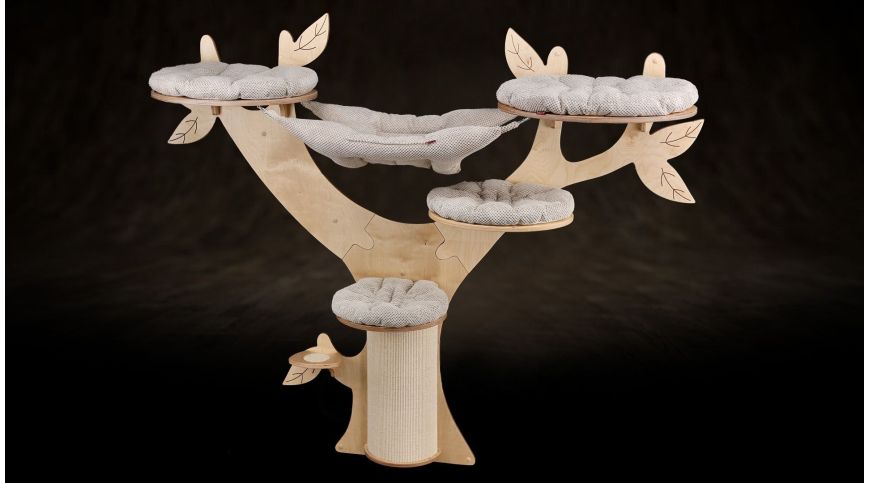
How Does a Wall-Mounted Cat Tree Differ from an Ordinary Cat Tree?
A traditional cat tree usually stands on the floor and is supported by one large base. A wall-mounted cat tree works differently. Its weight, as well as the forces created when cats jump and climb, is transferred through several branches, supports and mounting elements fixed directly to the wall.
A properly designed tree-shaped wall-mounted cat tree can serve simultaneously as:
- a scratching surface;
- a climbing route;
- several independent resting places;
- an observation point;
- a wall-mounted play area;
- a decorative feature in the home.
Wall mounting leaves the floor area free. This does not mean that the structure itself is small. The largest models occupy almost two metres of wall width. Instead of using a large floor base, they make use of the vertical space in the room.
For a Tree-Shaped Cat Tree, Construction Matters More Than Appearance
A wall-mounted cat scratching tree is a large three-dimensional construction. A cat does not merely rest on it. It jumps onto the branches at speed, pushes off from platforms, climbs between levels and changes direction suddenly. If several cats use the tree, loads may act on different parts of the construction at the same time.
For this reason, a wall-mounted cat tree should first be assessed as a load-bearing construction and only afterwards as a decorative item. An attractive trunk and branch shape is not enough if the platforms are too small, the supports are thin or the fixings are unsuitable for dynamic loads.
Plywood Quality and Thickness
The first thing to examine is the material used to manufacture the trunk, branches, platforms and wall-mounted components.
The statement “made of wood” is not sufficient. A structure may be made from thin plywood that bends under load, or from sufficiently thick multi-layer plywood that provides a high degree of rigidity.
Solid multi-layer plywood:
- bends less under the cat’s weight;
- holds screws and other mounting components more securely;
- resists lateral forces more effectively;
- allows larger platforms and beds to be made;
- maintains its geometry more effectively over many years of use.
Do not assess only the parts visible from the front. The components positioned against the wall, to which branches and supports are attached, are equally important. These parts carry a substantial proportion of the load.
Accurate Fit Between Individual Components
In a properly made cat tree, the components should fit closely together. Supports should not be installed at random angles or hold platforms in place solely through the tension of the screws.
A precise fit allows the load to be transferred through the whole contact surface. If gaps remain between the parts, a large proportion of the force may act directly on the screws, which can gradually create movement and looseness.
Before buying, check whether:
- the individual components fit closely together;
- the supports do not bend under pressure;
- the platforms do not rotate independently of the branches;
- the joints show no visible play;
- the structure remains rigid at its highest and most projecting points.
Support Thickness and Stability
A platform may be made from a good material and still remain unstable if it is supported by an element that is too thin, too short or incorrectly positioned.
The supports should be matched to:
- the size and weight of the platform;
- the distance between the platform and the wall;
- the expected weight of the cat;
- the forces produced when the cat jumps;
- the position of the platform within the complete tree.
The farther a platform projects from the wall, the greater the forces acting on its support and fixing. Large beds, hammocks and the outer branches require particular attention. The construction must withstand not only the weight of a cat lying still, but also the dynamic load created when the animal lands on it.
Wall Fixings, Screws and Mounting Points
The safety of a wall-mounted cat tree depends on the complete mounting system. Both the construction of the product and the way it is fixed to the particular wall are important.
Before buying, check:
- how many independent wall-fixing points the complete tree has;
- how widely the fixing points are distributed;
- the size of the screws used in structural connections;
- the size of the components that sit against the wall;
- whether the load is distributed across several branches and supports;
- whether the manufacturer provides clear assembly instructions.
A large number of fixing points is beneficial only when they are positioned correctly. Several screws located very close together will not distribute loads as effectively as independent mounting points spread over a larger area of the structure.
The Type of Wall Matters
Wall plugs and screws must be selected for the material from which the wall is constructed. Different fixing systems are required for:
- concrete;
- solid brick;
- hollow ceramic blocks;
- aerated concrete;
- plasterboard walls;
- walls with an additional timber or steel frame.
On a plasterboard wall, a heavy tree should not be attached only to the board itself. The mounting points must be connected to a sufficiently strong structure behind the board or to specially prepared reinforcement. If there is any doubt, the mounting system should be selected by a professional familiar with the construction of the particular wall.
Platform Size Must Match the Size of the Cat
One of the most important differences between wall-mounted cat trees is the actual size of the usable surfaces. A large overall width does not automatically mean that the cat will receive suitably spacious beds.
A wall-mounted tree cat scratcher may appear very elaborate but still have small platforms on which a larger cat cannot sit, turn around or lie down comfortably.
Before buying, check the dimensions of:
- platforms used as steps;
- sleeping areas;
- hammocks;
- the longest resting areas;
- the distances between successive levels.
The cat should be able to step onto a platform freely, turn around and support its whole body. For large breeds, long beds are particularly important because they allow the animal to rest with its body fully extended.
Which Wall-Mounted Cat Tree Should You Choose?
The category of tree-shaped wall-mounted cat trees contains five constructions that differ in size, number of resting places and intended use. The smaller models are suitable for small and medium-sized cats, while the largest trees have spacious beds designed for large breeds and Maine Coons.
Tree 1 – A Compact Wall-Mounted Cat Tree for Small and Medium-Sized Cats
Wall Mounted Cat Tree – Tree 1 is 135 cm wide and 151 cm high. It includes two beds measuring 60 × 41 cm and 40 × 40 cm, two steps and a scratching element 60 cm long.
This compact wall-mounted cat tree is well suited to one cat, small and medium-sized breeds, and rooms where a very wide section of wall cannot be allocated to the construction.
Tree 2 – Three Independent Resting Places
Wall Mounted Cat Tree – Tree 2 is 142 cm wide and 151 cm high. It offers three beds measuring 60 × 41 cm, 50 × 40 cm and 40 × 40 cm, as well as a step and a 60 cm scratching element.
This tree-shaped wall-mounted cat tree is a good option for a cat that likes to change resting places, or for several smaller cats using separate platforms at different heights.
Tree 3 – An Extended Tree-Shaped Cat Scratcher
Wall Mounted Cat Tree – Tree 3 is 187 cm wide and 165 cm high. It includes four resting places, including a larger 65 × 45 cm bed, and a replaceable scratching surface.
This model provides more space for medium-sized and larger cats. It is also suitable for homes where several cats use the same wall-mounted cat tree.
Tree 4 – A Large Wall-Mounted Cat Tree with a Hammock
Wall Mounted Cat Tree – Tree 4 is 198 cm wide and 171 cm high. In addition to several traditional resting areas, it features a large hammock measuring approximately 70 × 47 cm.
The variety of surfaces allows cats to choose between rigid platforms, soft beds and a suspended hammock. Thanks to the size of its components, this wall-mounted tree cat scratcher is also suitable for large cats and multi-cat households.
Tree 5 – A Wall-Mounted Cat Tree for Large Cats and Maine Coons
Wall Mounted Cat Tree – Tree 5 is 198 cm wide and 171 cm high. It includes a very large 50 × 80 cm bed, a 65 × 45 cm bed and a hammock measuring approximately 70 × 47 cm.
This is the largest tree-shaped cat tree in the group. It is especially well suited to large breeds, including Maine Coons, which often rest with their bodies fully extended and need considerably more space than a standard round basket provides.
A Replaceable Scratching Element – the Tree Does Not Have to Be Disposable
The scratching surface is a wear component. Even a very durable sisal mat may eventually need to be replaced after many years of intensive use.
In many wall-mounted cat trees, a worn scratching surface means removing the old material, attaching a new covering manually or dismantling a substantial part of the furniture. Rufi trees use a separate, replaceable scratching module.
When it becomes worn, the entire tree does not have to be removed from the wall and no complicated renovation is required. The module can be unscrewed and replaced with a new one within seconds.
The replacement element for the Wall Mounted Cat Tree can be ordered after years of use or purchased as a spare part at the same time as the tree.
This solution offers several important advantages:
- the complete construction does not need to be discarded;
- replacement does not require specialist tools;
- the tree does not have to be removed from the wall;
- only the part that has actually worn out is replaced;
- the cost of continued use is far lower than buying a new piece of furniture.
A replaceable scratching surface is particularly important for a large wall-mounted cat tree selected to match the interior, because such a piece of furniture should be designed to serve cats for many years.
Easy Cleaning and Removable Textile Components
A wall-mounted cat tree should be easy to clean thoroughly without dismantling the whole construction.
On Rufi models, the poufs and cushions can be removed and washed at temperatures up to 40°C. Once the textile components have been removed, the wooden surfaces are easily accessible and can be wiped clean.
This is far more practical than permanently covering entire platforms with plush or carpet. Fixed upholstery gradually collects dust, fur and dirt that cannot be removed thoroughly in a washing machine.
Before buying, check:
- whether the cushions and poufs are removable;
- whether the textile elements are washable;
- whether the surfaces underneath them are properly protected;
- whether replacement textile elements can be ordered;
- whether all platforms are easy to access for cleaning.
Where Should You Install a Wall-Mounted Cat Tree?
The best location should be attractive to both the cat and the household. Suitable options include:
- a wall in the living room;
- a location close to a window;
- a position from which the cat can observe most of the room;
- a wall in a room where household members spend a lot of time;
- a place not obstructed by tall furniture.
Cats often want to rest where everyday household life takes place. Even the best wall-mounted cat scratching tree may be used infrequently if it is installed in a dark, isolated room.
There should also be sufficient free space in front of the construction. The cat must be able to jump safely onto the lower steps and descend without the risk of striking a table, cabinet or other furniture.
Wall-Mounted Cat Tree – Checklist Before Buying
- What type and thickness of plywood are used for the trunk, branches and platforms?
- Are the components sufficiently thick and rigid?
- Are the supports strong and properly fitted?
- How many independent wall-fixing points does the construction have?
- Are the platforms and beds large enough for my cat?
- Are the distances between levels suitable for the cat’s mobility?
- Is the scratching surface easy to access?
- Can a worn scratching element be replaced quickly?
- Can the cushions and poufs be removed and washed?
- Is the chosen wall suitable for securely mounting the complete tree?
Frequently Asked Questions
What Is a Wall-Mounted Cat Tree?
It is a piece of wall-mounted cat furniture designed in the form of a trunk and branches. It includes platforms, beds, steps and a scratching surface. Unlike a traditional cat tree, it does not stand on one floor base, but is fixed to the wall at multiple points.
How Does a Tree-Shaped Cat Tree Differ from an Ordinary Cat Tree?
A traditional cat tree occupies floor space and is supported by a base. A tree-shaped wall-mounted cat tree uses vertical space, with its platforms and branches attached to the wall. It functions as a scratching post, climbing route, resting area and decorative element at the same time.
Is a Wall-Mounted Cat Tree Suitable for a Small Apartment?
Yes, because it does not occupy a large area of the floor. However, a sufficiently wide and strong wall is required. The smallest models are approximately 135–142 cm wide, while the largest are nearly 200 cm wide.
Which Wall-Mounted Cat Tree Should I Choose for a Large Breed?
For a large cat, choose a model with spacious beds, strong supports and multiple fixing points. The length of the resting areas is particularly important. Tree 5 includes a 50 × 80 cm bed, which makes it well suited to large cats and Maine Coons.
Can the Scratching Surface Be Replaced?
Rufi trees use a replaceable module covered with a sisal mat. The worn surface can be replaced without removing the entire tree from the wall and without manually restoring the construction.
Where Is the Best Place to Install a Wall-Mounted Cat Tree?
Choose a location where the cat already likes to spend time, such as the living room, an area near a window or a wall that provides a good view of the room. The structure must be fixed to a strong wall, with enough free space for safe jumping and descending.
Summary
A good wall-mounted cat tree should combine an impressive appearance with a solid and carefully designed construction. Its quality is not determined solely by the shape of the trunk, the number of decorative branches or its overall size.
The most important features are:
- sufficiently thick multi-layer plywood;
- rigid and accurately fitted supports;
- solid connections and correctly distributed fixing points;
- large, functional platforms;
- washable textile components;
- a replaceable scratching surface;
- a model matched to the cat’s size and mobility.
A properly made and installed tree-shaped wall-mounted cat tree can serve for many years as a place for climbing, scratching, observation and rest, while remaining a distinctive part of the interior design.
Leave a Reply Cancel Reply